
Foot & Ankle Pain Diagnostic Ultrasound Scans
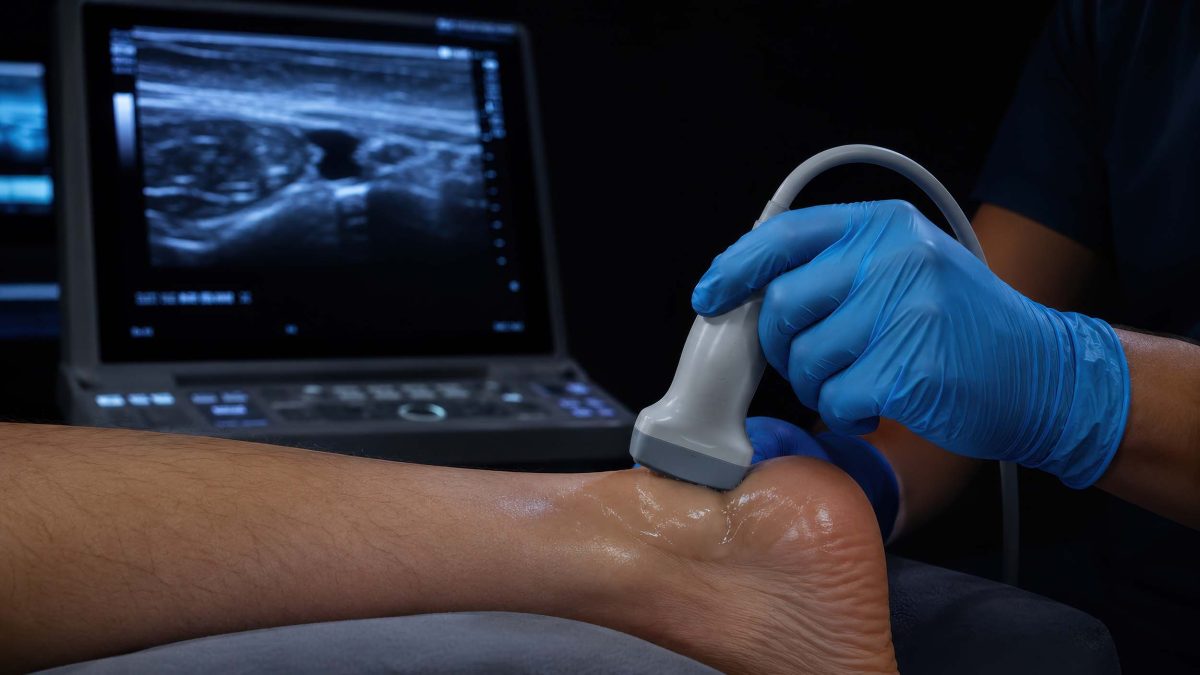
See what is causing your pain, not just guess at it. At The Farnham Foot Clinic, our musculoskeletal podiatrists use diagnostic ultrasound to look directly at the tendons, ligaments, fascia and soft tissues of your foot and ankle during your appointment, so your diagnosis is based on what we can actually see.
Why choose an ultrasound scan for foot pain?
Many foot and ankle problems feel similar. Heel pain, for example, can come from the plantar fascia, a bursa, a nerve or a tendon, and each needs a different approach. A hands-on examination tells us a great deal, but ultrasound lets us confirm the diagnosis rather than assume it.
- See it on screen: you can watch the images as we scan.
- Treatment that targets the real problem: knowing exactly which structure is involved, and how severe the change is, shapes the right treatment from the start.
- Progress you can measure: repeat scans can show how tissue is responding to treatment over time.
- Safe and comfortable: ultrasound uses sound waves, with no radiation and no needles. It is painless and suitable for most people.
- No long NHS wait: appointments are usually available within days, not months.
Conditions we assess with ultrasound
Diagnostic ultrasound is particularly useful for soft-tissue problems in the foot and ankle, including:
- Plantar fasciitis and heel pain: measuring plantar fascia thickness and identifying tears or other causes of heel pain.
- Achilles tendinopathy: assessing tendon thickening, structural change and partial tears.
- Morton’s neuroma: confirming a neuroma between the toes and distinguishing it from bursitis or joint problems.
- Ankle sprains and ligament injuries: checking the ligaments after a roll or twist that has not settled.
- Tendon problems: including the tibialis posterior (linked to flattening arches) and peroneal tendons on the outside of the ankle.
- Shin pain (shin splints): looking at the tendons and soft tissues along the shin, and helping decide whether further imaging is needed.
- Bursitis: inflamed fluid-filled sacs around the heel and forefoot.
- Plantar plate injury: a common cause of pain under the ball of the foot.
- Swelling: around the tendons and joints of the foot and ankle.
Ultrasound is not the right test for every problem. If we suspect something that needs a different type of imaging, such as a stress fracture, we will explain why and advise you on the next step.
Your ultrasound appointment options
Biomechanical Assessment with Ultrasound Scan (75 minutes)
Our most complete option for anyone with foot, ankle or lower-limb pain. Your podiatrist will take a full history, examine your feet and legs, assess how you walk, and use ultrasound to confirm the diagnosis. Your care then continues with follow-up appointments to review your progress.
Standalone Ultrasound Scan (30 minutes)
A focused scan of a specific area, with a written report. Once your report is ready, we book you in for an in-depth discussion of your results. You can book this directly, with no prior assessment needed. It is ideal if you want a clear answer about a specific problem, have been referred by your GP or physiotherapist, or need to check progress during treatment.
What happens during the scan?
- Discussion: we talk through your symptoms, history and what matters most to you, whether that is walking the dog, running or getting through a working day comfortably.
- Examination: we examine the painful area to decide exactly where to scan.
- The scan: a small amount of gel is applied and a handheld probe is moved gently over the skin. You can watch the images on screen as we scan.
- Your report: your podiatrist prepares a written report of your scan, which you can also share with your GP, physiotherapist or consultant.
- Your results appointment: once your report is ready, we book you in for an in-depth discussion of your results, what they mean for you, and your treatment options, such as targeted exercises, footwear advice, custom orthotics or shockwave therapy.
Please wear loose trousers or shorts so the area can be easily reached, and bring any previous scan or X-ray reports.
From diagnosis to treatment, under one roof
A scan is only valuable if it leads to the right treatment. Because our team specialises in musculoskeletal podiatry, your findings feed directly into your care here at the clinic:
Who performs your scan?
Your scan is performed by one of our ultrasound-trained musculoskeletal podiatrists. Our ultrasound service is led by Maria Venegas Sanchez, Senior Podiatrist and Head of Musculoskeletal Podiatry, BSc (Hons) Podiatry, PgDip Diabetes, PgCert Musculoskeletal Ultrasound (Foot & Ankle), MRCPod.
All our podiatrists are degree-educated, registered with the Health and Care Professions Council (HCPC) and members of the Royal College of Podiatry.
Easy to reach, with free parking
The Farnham Foot Clinic is at Farnham Business Park, Weydon Lane, Farnham, Surrey GU9 8QT, just off the A31, with plenty of free on-site parking. We regularly see patients from Farnham, Aldershot, Farnborough, Fleet, Alton, Guildford, Godalming, Camberley and across Surrey and Hampshire.
Book a Standalone Ultrasound Scan
Book a Biomechanical Assessment with Ultrasound
Frequently asked questions
Do I need a GP referral for an ultrasound scan?
No. You can book directly with us. We also welcome referrals from GPs, physiotherapists and other healthcare professionals.
Is a foot ultrasound scan painful?
No. The scan is painless. If an area is already tender, we apply only gentle pressure and will check you are comfortable throughout.
How long does the scan take?
A standalone scan appointment lasts 30 minutes. A full biomechanical assessment with ultrasound lasts 75 minutes.
Can I book a scan without an assessment first?
Yes. You can book a standalone ultrasound scan directly, with no prior assessment or referral needed.
When will I get my results?
Your podiatrist prepares a written report of your scan. Once it is ready, we book you in for an in-depth discussion of your results and what they mean for you.
Can ultrasound diagnose plantar fasciitis?
Yes. Ultrasound can measure the thickness of the plantar fascia and show changes associated with plantar fasciitis, as well as help rule out other causes of heel pain.
Can ultrasound detect Morton's neuroma?
Yes. Ultrasound is a well-established way to identify Morton's neuroma and to tell it apart from other causes of forefoot pain, such as bursitis or plantar plate injury.
Can I claim on my health insurance?
Many private health insurers cover podiatry and diagnostic services. Please check with your insurer before your appointment. We provide a detailed invoice you can use to make a claim.