
Plantar Fasciitis Treatment in Farnham
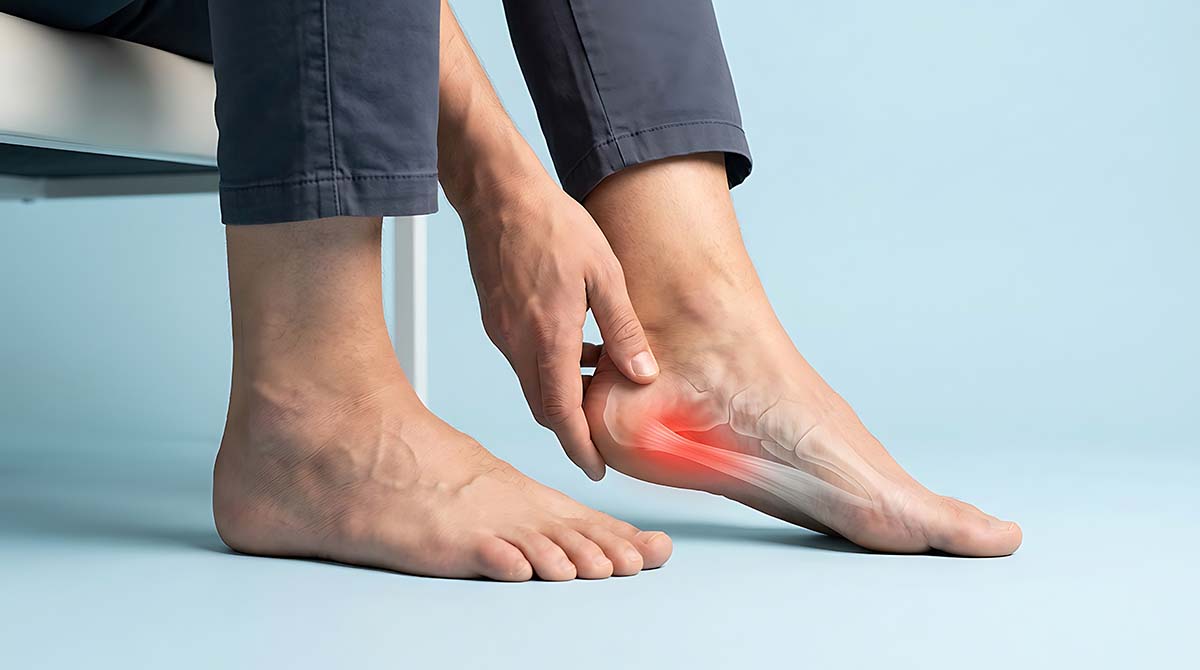
Sharp pain under your heel when you get out of bed? Aching after a walk, a run or a long day on your feet? You are not alone. Around one in ten people will have plantar heel pain at some point in their life.1 The encouraging news is that, with proper treatment, around 80% of people with plantar fasciitis improve within 12 months.1
At The Farnham Foot Clinic, our musculoskeletal podiatrists assess your heel pain and treat it with an approach tailored to you, combining exercise, footwear advice, orthoses and shockwave therapy where they will help.
Book a heel pain assessment or call 01252 717 177
- No referral needed
- Diagnostic ultrasound on site
- Free parking
Does this sound like you?
- Stabbing pain under the heel with your first steps in the morning, or when you stand up after sitting.
- Pain that eases a little once you get moving, then returns after a long walk or standing for hours.
- Tenderness on the underside of the heel, sometimes spreading into the arch.
- Heel pain that has lasted weeks or months despite rest, stretching or new shoes.
If this is you, book an assessment with one of our musculoskeletal podiatrists.
What is plantar fasciitis?
The plantar fascia is a thick band of tissue that runs from your heel bone to your toes and supports your arch. When it is overloaded, it becomes thickened and painful where it attaches to the heel. It is also known as plantar fasciopathy.1
It is common in runners, but it also affects people who are not very active. Recognised risk factors include reduced ankle flexibility, a higher body weight, and standing for long periods.1 A sudden increase in activity or a change of footwear can also trigger it.2
Not all heel pain is plantar fasciitis. Pain can also come from the Achilles tendon, the heel fat pad, a bursa, an irritated nerve or a stress fracture.2 In active children and teenagers, heel pain is often Sever’s disease. That is why we start with a proper assessment.
What about heel spurs?
If you have been told you have a heel spur, do not worry. Heel spurs are found in around 11–16% of the general population, many of whom have no pain at all,3 and finding one on an X-ray does not change how heel pain is treated.4 It does not mean you need surgery, and it does not mean your pain cannot get better.
Your heel pain assessment
Everything starts with a 60-minute biomechanical assessment with one of our musculoskeletal podiatrists. We take a full history, examine your foot and leg, and look at how you move, using pressure-mapping analysis where helpful.
Want to see what is going on from day one? Book the assessment with ultrasound scan (75 minutes) and we can look at your plantar fascia on screen in the same appointment.
Recovery from heel pain takes time, so your care continues with follow-up appointments, where we review your progress and adjust your treatment as you improve.
Diagnostic ultrasound: see what is causing your pain
Diagnostic ultrasound gives you clarity from the start, and it is a recognised next step when heel pain has lasted more than three months despite treatment.1 It shows the plantar fascia and surrounding tissue on screen. Research shows that people with chronic heel pain have a plantar fascia that is, on average, over 2 mm thicker than people without heel pain, and that a thickness above 4 mm is strongly associated with plantar fasciitis.5 A scan can also help identify other causes of heel pain.
Our diagnostic ultrasound service is led by our Head of Musculoskeletal Podiatry, who holds a postgraduate certificate in musculoskeletal ultrasound of the foot and ankle.
Our combined approach to treating heel pain
Heel pain rarely has a single cause, so it rarely has a single fix. Our approach follows a published best-practice guide for plantar heel pain, built from a systematic review of the research, expert opinion and patient feedback.6 Your plan brings together the treatments most likely to work for you, each supporting the others:
1. Strengthening and stretching
The foundation of your recovery. Plantar fascia stretching reduces first-step pain in the short term,6 and in a randomised trial of people with ultrasound-confirmed plantar fasciitis, slow, high-load heel-raise strengthening led to better outcomes at three months than stretching alone.7 We guide you through your programme and progress it at your follow-up appointments.
2. Footwear advice and education
Practical guidance on the shoes that suit your feet, your work and your sport, and how to stay active while you recover, rather than stopping everything. Education and footwear advice are part of the core approach in the best-practice guide.6
3. Orthoses, where your assessment shows they will help
Where your foot mechanics are adding load to the heel, we prescribe custom orthotics, made to fit your feet and your everyday shoes.
4. Shockwave therapy alongside your rehabilitation
The best-practice guide supports adding shockwave therapy in a stepped approach for heel pain that has not improved with core treatment,6 and a 2023 systematic review found shockwave improved pain in the medium and long term compared with control.8
Why choose The Farnham Foot Clinic?
- Musculoskeletal podiatrists, led by our Head of Musculoskeletal Podiatry.
- Diagnostic ultrasound on site, with a written report.
- Assessment, scanning, orthoses and shockwave therapy under one roof: one clinic, one plan.
- Treatment grounded in current research, explained clearly.
- HCPC-registered podiatrists, members of the Royal College of Podiatry.
- Free on-site parking at Farnham Business Park, just off the A31.
- No referral needed. Book directly.
When to seek medical advice urgently
Please contact your GP or NHS 111 promptly if your heel pain started after a fall or injury and you cannot put weight on your foot, if your heel is hot, red and swollen, if you feel unwell or have a fever, or if you have numbness or tingling in your foot.
Serving Farnham and surrounding areas
We see patients from Farnham, Aldershot, Farnborough, Fleet, Alton, Guildford, Godalming, Camberley and across Surrey and Hampshire. Find us at Farnham Business Park, Weydon Lane, Farnham, Surrey GU9 8QT.
Take the first step towards pain-free mornings
Heel pain: frequently asked questions
How long does plantar fasciitis take to get better?
It varies from person to person. With proper treatment, around 80% of people improve within 12 months.1 Treating the factors that are overloading your plantar fascia gives you the best chance of a steady recovery.
What happens at a heel pain assessment?
A 60-minute appointment with a musculoskeletal podiatrist, covering your history, an examination and a look at how you walk. You can add an ultrasound scan by booking the 75-minute assessment with ultrasound. Your care then continues with follow-up appointments to review and progress your treatment.
Should I have an ultrasound scan for heel pain?
A scan gives you clarity from the start. Diagnostic ultrasound shows your plantar fascia on screen, measures any thickening, and helps rule out other causes of heel pain, such as a problem with a tendon, a bursa or the heel fat pad. That means your treatment can be targeted from day one. To include a scan, book the 75-minute assessment with ultrasound.
Is my heel spur causing my pain?
Not necessarily. Heel spurs are found in many people without heel pain, and finding one on an X-ray does not change how heel pain is treated.3,4
Is shockwave therapy right for me?
Shockwave is most often used for heel pain that has not settled with exercise and other treatment, as part of your wider plan rather than on its own. Your podiatrist will tell you at your assessment whether it is suitable for you.
Will I need orthotics?
If your assessment shows that the way your foot works is adding load to your heel, we will recommend orthoses as part of your plan.
Do I need a GP referral?
No. You can book directly with us.